


· By Aussie Biltong
Biltong Price Per Kg in Australia: What You Should Actually Pay
The first time most people see biltong priced by the kilo, they put it straight back down.
A hundred dollars and change for a kilogram of dried beef. Next to a supermarket steak at twenty-something a kilo, it looks absurd. It looks like someone worked out that health-conscious Australians will pay anything if you put the word premium on the label.
That reaction is fair. It is also based on a comparison that does not hold, and once you see why, the price stops looking like a markup and starts looking like arithmetic.
Here is what actually determines biltong pricing in Australia, what a fair price looks like, and the specific signals that tell you when you are being overcharged for something inferior.
The number that explains everything
Biltong is not beef. Biltong is what is left of beef after you take the water out.
Roughly three kilograms of raw beef becomes one kilogram of finished biltong. Around 65% of the starting weight leaves as moisture during the slow-drying process. That is not a rounding error. That is the entire product.
So before a single other cost enters the equation, one kilogram of biltong already contains three kilograms of beef. Price that beef at a fair rate for quality Australian grass-fed topside and you are already well past what the finished kilo looks like it should cost.
That is the number nobody puts on the shelf label, and it is the only one that matters. If you want the detail on how the moisture leaves and why it takes as long as it does, we covered it in how slow-drying actually works.
What you are paying for besides the beef
Three kilos of beef per finished kilo is the floor. On top of that sit four costs that separate real biltong from the cheap stuff.
Time
Proper biltong is slow-dried over 7 to 14 days, flipped every few hours so it dries evenly. That is up to two weeks of controlled temperature, controlled humidity, and someone physically handling the product multiple times a day.
The window is a range rather than a fixed number for a reason. Airflow direction and intensity change how quickly moisture leaves the meat, so a batch is finished when it reaches the right texture and moisture level, not when the calendar says so. Judging that is the skill, and it is why biltong is still made by people rather than machines.
Industrial dehydration does the same job in six to eight hours with heat. It is dramatically cheaper. It also produces a different product: tough, brittle, cooked rather than cured. Time is the single biggest cost difference between biltong and jerky, and it is the one you can taste.
The cut
Lean, dense cuts like topside and silverside cost more than the trim and offcuts that go into mass-market meat snacks. They also dry evenly and produce biltong you can chew without effort. We go into this properly in our guide to choosing the right meat for biltong.
Where the beef comes from
Australian grass-fed beef costs more than grain-finished feedlot beef, and considerably more than imported frozen beef processed onshore. Grass-fed carries a better fat profile, deeper flavour, and a supply chain you can actually name.
What is not in it
This one is counterintuitive. Leaving ingredients out costs more, not less.
Sugar and glucose syrup are cheap bulking agents that add weight and mask flavour. Soy protein is cheap filler. Preservatives let a producer run faster, hotter, and hold stock longer with less waste. Every one of those shortcuts lowers the cost per kilo.
A five-ingredient product with no sugar, no fillers and no preservatives has nowhere to hide and no way to pad the weight. We broke down what goes into the cheap alternatives in what's really in your jerky.
What biltong should cost per kg in Australia
Price per kilo falls as pack size increases, because packaging and handling are fixed costs spread across more product. Here is the full ladder, so you can see exactly what you pay at each size.
| Pack size | Price | Price per kg | Cost per 50g serve |
|---|---|---|---|
| 100g | $18.00 | $180.00 | $9.00 |
| 250g | $34.99 | $139.96 | $7.00 |
| 500g | $64.99 | $129.98 | $6.50 |
| 750g | $92.99 | $123.99 | $6.20 |
| 1kg | $114.99 | $114.99 | $5.75 |
| 1.25kg | $139.99 | $111.99 | $5.60 |
| 1.5kg | $164.99 | $109.99 | $5.50 |
| 1.75kg | $189.99 | $108.57 | $5.43 |
| 2kg | $215.99 | $108.00 | $5.40 |
The spread is significant. Buying in 100g packs costs $180 per kilo. Buying by the kilo costs $114.99. That is a 36% difference for exactly the same biltong, cut from exactly the same beef, out of exactly the same batch.
And those are the full prices before any discount. Every one-off order gets 5% off automatically, and subscribers get 10% off every order for as long as they stay. More on that below, because it changes the maths considerably.
The comparison that actually makes sense
Nobody eats a kilogram of biltong in one sitting. The per-kilo figure is useful for comparing producers and useless for understanding what it costs you to eat.
A 50g serve delivers around 30g of complete protein and under 2g of carbohydrate. At the 1kg price that serve costs $5.75. On a 2kg subscription it drops to $4.86.
Now, a protein bar costs around $4.50, so on the face of it that looks like a draw. It is not, because you are not buying wrappers. You are buying protein.
- Biltong: $4.86 for around 30g of complete protein = roughly 16 cents per gram of protein
- Protein bar: $4.50 for 15 to 20g of protein = roughly 25 cents per gram of protein
- Servo meat snack: $6 to $8 for a small serve, usually loaded with sugar and preservatives
- Cafe protein ball: $5 to $6, mostly dates and syrup
Biltong delivers protein at about 35% less per gram than a protein bar. And it does it with under 2g of carbohydrate, zero added sugar, and a label you can read, rather than 8 to 15g of sugar and a list you need to squint at. We compared it head to head against the alternatives in our post-workout protein breakdown.
Four signs you are overpaying
A high price per kilo is not automatically a bad deal, and a low one is not automatically a bargain. What matters is what you get for it. Four things to check on any producer, including us.
1. The ingredient list runs past eight items
Real biltong is beef, vinegar, salt, coriander, black pepper, and possibly one or two additions for a flavoured version. Anything past that is padding. If you see sugar, glucose, dextrose, maltodextrin, soy protein, sodium nitrite or MSG, you are paying premium prices for a commodity product.
2. The producer will not say where the beef comes from
A brand buying properly will tell you the country, usually the state, sometimes the farm. Vagueness here is always deliberate.
3. The drying time is unstated or under a week
If a producer does not publish their drying window, ask. Anything under a week is heat-dehydrated, not slow-dried. That is a fundamentally cheaper process being sold at biltong prices.
4. The biltong is wet
The oldest trick in the category. Water is heavier than dried beef and costs nothing. Under-drying means more weight per batch and more revenue per kilo of raw beef. It also means shorter shelf life and a far higher chance of surface mould in the pack. Properly dried biltong is firm but pliable, never damp.
How to pay the lowest honest price
If you have decided quality matters, there are exactly two levers that reduce what you pay without reducing what you get.
The first is pack size. Moving from 100g to 1kg cuts the per-kilo rate by 36%. Same product, better rate, simply because you are not paying to package it nine separate times.
The second is subscribing. Every one-off order with us gets 5% off automatically. Subscribing takes that to 10% off every order, permanently, with no obligation and no lock-in. Pause it, change the frequency, or cancel entirely whenever you like.
We are open about why we price it that way. Recurring orders let us forecast production properly, dry to a known schedule rather than guessing, and hold less idle stock. That efficiency is what funds the deeper discount, and over time it is what lets us widen the range and bring new flavours to subscribers first. You get a better price and never run out. We get a business we can plan. Both halves are real.
Stack both and a kilo comes to $103.49, which is $5.17 for a 50g serve carrying around 30g of protein.
| Size | RRP | One-off (5% off) | Subscription (10% off) |
|---|---|---|---|
| 1kg | $114.99 | $109.24 | $103.49 |
| 1.25kg | $139.99 | $132.99 | $125.99 |
| 1.5kg | $164.99 | $156.74 | $148.49 |
| 1.75kg | $189.99 | $180.49 | $170.99 |
| 2kg | $215.99 | $205.19 | $194.39 |
Where our pricing sits and why
Aussie Biltong runs $114.99 per kilogram at the 1kg size, or $103.49 on subscription. That covers roughly three kilos of Australian grass-fed topside, 7 to 14 days of slow-drying with the strips flipped every few hours, hand-applied spice, and free express delivery Australia-wide on orders over $150.
It is made in Sydney by Chef Mark, who trained in professional cookery after arriving from Slovakia and spent years in some of the country's most respected kitchens, including the one-hatted Galileo and the two-hatted Rockpool Bar & Grill. In 2012 he and his brother Jan opened Ahgora, now Ahgora Taverna at 31 Norton St, Leichhardt. That is the standard the biltong is held to.
Every size ships as resealable 250g pouches rather than one large bag. A kilo arrives as four sealed pouches, a two kilo as eight. You open one at a time and the rest stay factory-sealed until you get to them, so buying the better per-kilo rate costs you nothing in freshness.
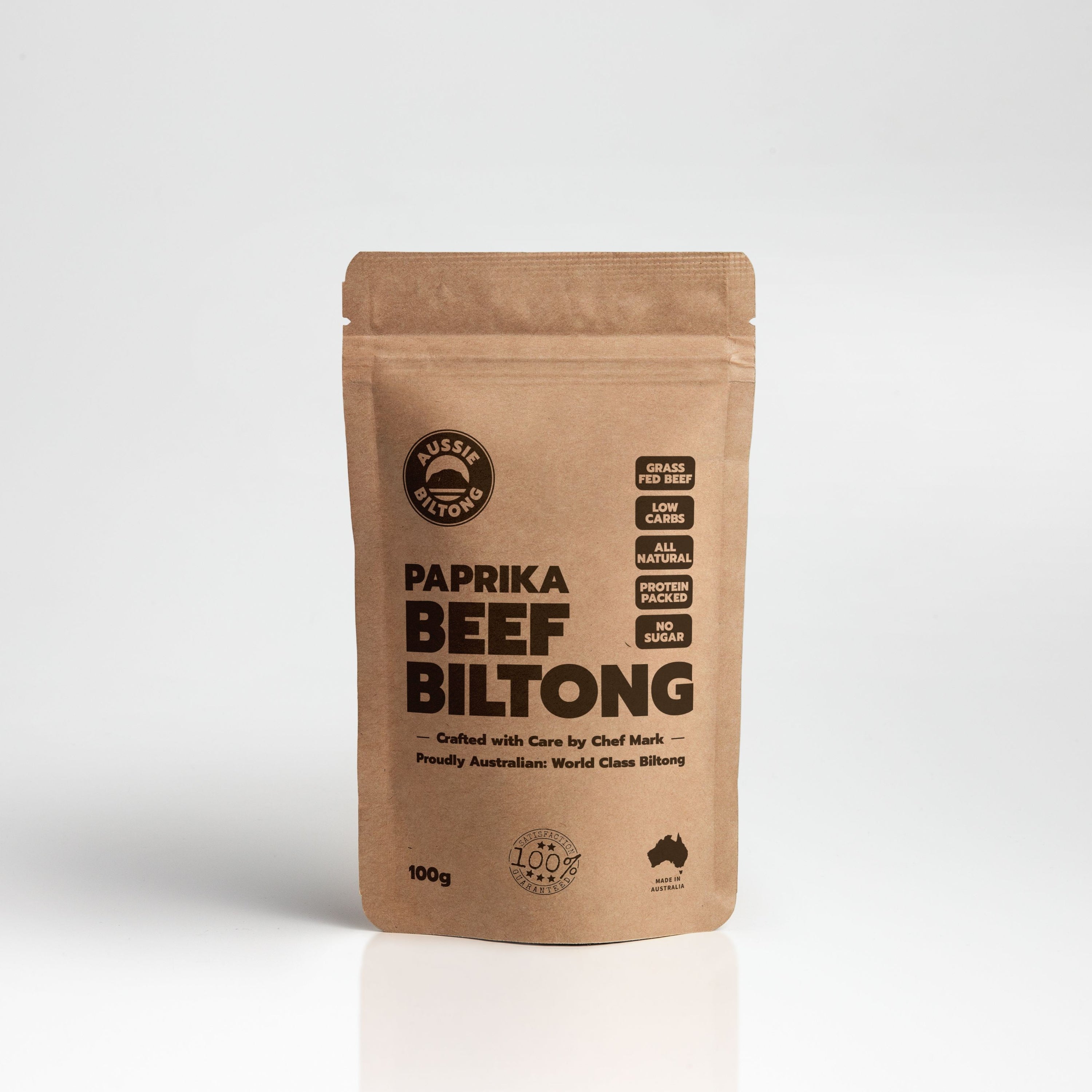
Two flavours at the same price. Original is the traditional coriander, black pepper and vinegar cure. Paprika adds smoked paprika and garlic over the same base. The full range and every pack size is here.
And if you decide it was not worth it, you do not have to argue with us about it. If you are not 100% satisfied, we offer a 100% money-back guarantee. The price question is ours to answer, not your risk to carry.
FAQ
How much does biltong cost per kg in Australia?
Expect roughly $108 to $180 per kilogram depending on pack size, with larger packs dropping the rate substantially. Aussie Biltong runs $114.99 per kg at 1kg and $108.00 per kg at 2kg, before the automatic 5% one-off discount or the 10% subscriber discount. Anything dramatically below market usually signals under-drying, filler ingredients, or cheaper imported beef.
Why is biltong so expensive compared to beef?
Because roughly three kilograms of raw beef produces one kilogram of finished biltong. About 65% of the starting weight is water that leaves during slow-drying. Add 7 to 14 days of controlled drying, lean premium cuts, and no cheap bulking agents, and the price follows from the maths.
How much does a serve of biltong cost?
A 50g serve, carrying around 30g of complete protein, works out at $5.75 at the 1kg price or $4.86 on a 2kg subscription. Per gram of protein that is roughly 35% cheaper than a typical protein bar.
Is cheap biltong worth buying?
Usually not. The three most common ways to lower the price are under-drying so water adds weight, adding sugar and soy filler, and using cheaper imported or grain-finished beef. All three produce a worse product and the first shortens shelf life considerably.
What is the cheapest way to buy biltong?
Buy the largest pack you will realistically eat, and subscribe. A 2kg subscription works out at $97.20 per kg against $180 per kg in 100g packs. Subscriptions carry no obligation and can be cancelled anytime. Because every size ships as resealable 250g pouches, buying big carries no freshness penalty, and our guide to storing biltong covers the rest.
What if I do not think it is worth the price?
Then you get your money back. If you are not 100% satisfied, we offer a 100% money-back guarantee, on any size.