


· By Aussie Biltong
How Traditional Slow-Drying Works: The Science Behind Tender, Preservative-Free Biltong

Pick up a packet of mass-market jerky and read the back. Sodium nitrite. Sodium erythorbate. BHA. Hydrolysed vegetable protein. Sugar. Glucose syrup. Some of those names are doing flavour work. Most are doing preservation work. We broke down the worst of them in what's really in your jerky, but the short version is this: shelf-stable jerky relies on chemistry to stay safe to eat for twelve months in a hot warehouse.
Pick up a packet of Aussie Original Beef Biltong and read the back. Beef. Vinegar. Salt. Coriander. Black pepper. That is it. No preservatives. No nitrates. No sugar. No starch.
Same shelf life category as jerky. Same protein density. Different ingredient list by a factor of six. So how does it work? How is biltong made safe to eat without the chemical cocktail?
The answer is a 200-year-old preservation method that uses three things modern food science still cannot improve on. Acid. Salt. Time. We call it slow-drying, because that is the part that actually matters: the meat is never cooked, never rushed, and comes out when it is ready rather than when a timer says so.
Below is the science of how it works, the reason biltong is naturally preservative-free, and what happens to a strip of beef across the one to two weeks it spends in our drying room.
How is biltong made? The 5-step process, explained
Traditional biltong production has not changed meaningfully since Dutch settlers added vinegar to the meat-drying methods of the Khoikhoi people of Southern Africa in the 1600s. Modern producers like us use stainless steel cabinets and food-grade humidity control instead of the open veld, but the chemistry is identical.
Step 1: Cut and trim (Day 0)
Real biltong starts with the right cut of beef. We use grass-fed Australian silverside and topside, which are lean cuts from the back leg of the animal. Excess fat is trimmed off. Fat does not slow-dry well. It traps moisture, slows the cure, and is the single biggest cause of off-flavours and surface mould. We go deeper on cut selection in our guide to choosing the right meat for biltong.
The trimmed muscle is cut into strips roughly 6-10mm thick along the grain. Thicker strips dry unevenly. Thinner strips lose too much weight and end up brittle.
Step 2: The vinegar bath (Day 0, 30 minutes)
This is the step most people have never heard of, and it is doing more work than any other ingredient in the process.
Each strip is bathed in apple cider vinegar or brown vinegar. The vinegar drops the pH of the surface of the meat from a neutral 5.6 down to around 4.5. At pH 4.5, most spoilage bacteria, including E. coli and Listeria, cannot grow. The acid does what sodium nitrite does in jerky, with no chemistry textbook required.
The vinegar also denatures the surface proteins. This is why biltong is tender rather than tough. The acid begins breaking down the muscle fibres before the salt and the air ever touch the meat.
Step 3: Spice cure (Day 0, overnight)
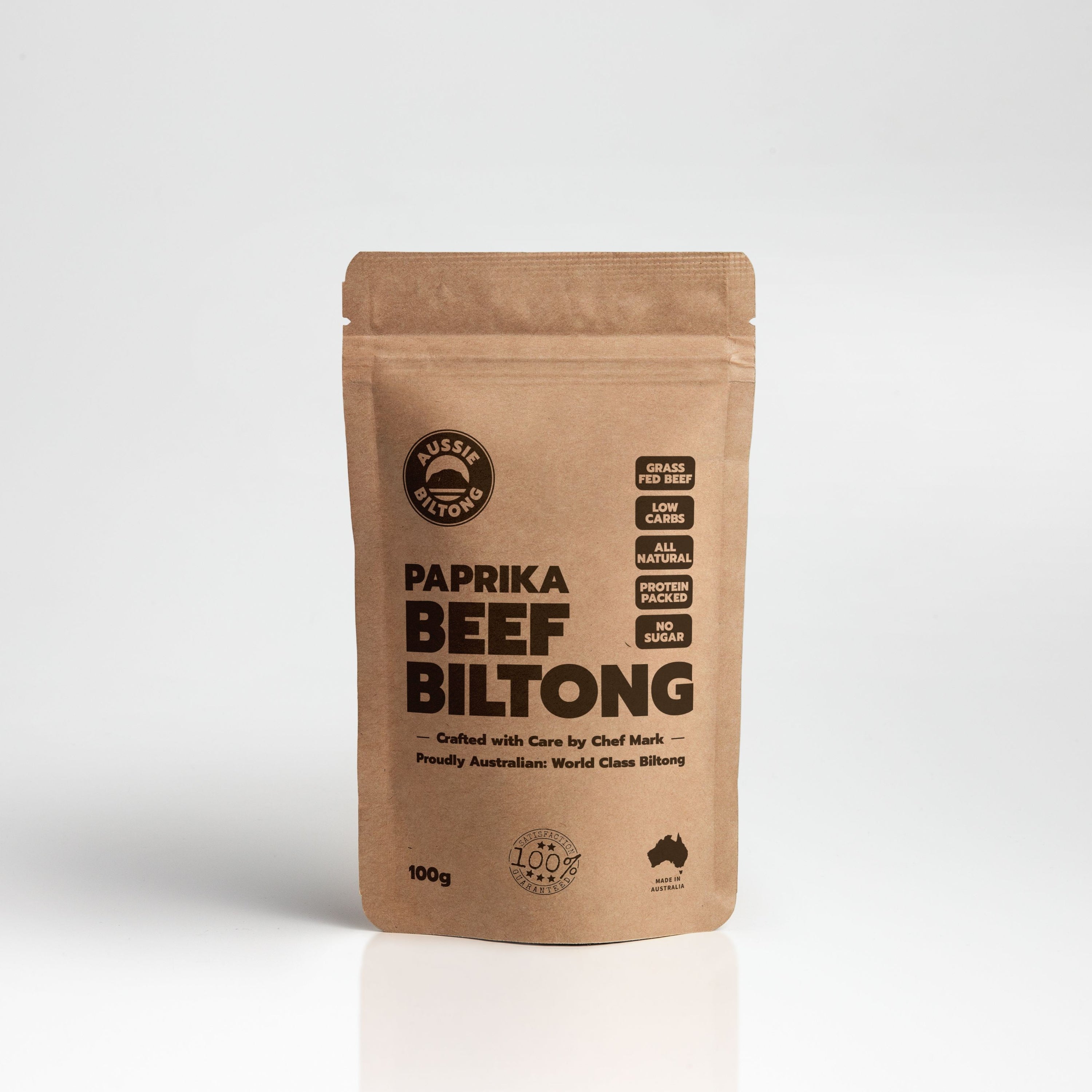
After the vinegar bath the strips are coated by hand in coarse salt, ground coriander, and cracked black pepper. Other spices vary by recipe. Ours is a blend Chef Mark developed across a career in professional kitchens. The Original blend is built around the traditional South African recipe. The Paprika blend adds smoked paprika, garlic, and extra cracked black pepper, which you can taste in our Aussie Paprika Beef Biltong.
The salt is doing two jobs at once. The first is flavour. The second is osmosis. Salt pulls water out of the meat and out of any bacteria sitting on the surface. Bacteria need water to multiply. No water, no bacteria. This is the same principle that makes salt cod, prosciutto, and country ham safe to eat without refrigeration. It is one of the oldest food preservation techniques on Earth, and it still works.
Coriander seed contains natural antimicrobial oils. The traditional spice mix is not just for taste. Every ingredient earns its place in the preservation system.
The strips are left to cure overnight, usually 8-12 hours, while the salt and the vinegar do their work.
Step 4: The slow-dry (Day 1 to Day 7-14)
This is where biltong becomes biltong.
The cured strips are hung in a cool, ventilated drying cabinet at around 20-25°C with controlled humidity, usually 50-60%, and flipped every few hours so they dry evenly. Air circulates around each strip continuously. No heat is applied. No smoke is added. The meat is never cooked.
Over the following one to two weeks, water evaporates slowly from the muscle. The strip loses about 70% of its starting weight. Roughly 3kg of raw beef becomes 1kg of finished biltong. This is why biltong is calorie-dense and nutrient-dense per gram. You are eating concentrated meat.
Why the range rather than a fixed number of days? Because airflow direction and intensity change how quickly moisture leaves the meat. Two batches hung on the same day can finish days apart depending on how the air moves through the cabinet. A batch comes out when it reaches the right texture and moisture level, not when the calendar says so. Judging that is the skill, and it is why biltong is still made by people rather than machines.
The science behind why this works is a measurement called water activity, written as aw. Fresh meat has a water activity of around 0.99. Bacteria, yeasts, and moulds need a water activity above 0.85 to grow. Once slow-drying brings the water activity below 0.85, the product is microbiologically stable. No preservatives required. No refrigeration required for the unopened pouch.
This is the entire reason biltong can sit on a shelf for months in a sealed pouch with no chemical preservatives. The water has been removed. There is nothing left for bacteria to grow on.
Step 5: Slice, pack, ship
Once the strip reaches the target water activity and texture, it comes out of the drying cabinet. It is sliced against the grain into bite-sized pieces and weighed into resealable 250g pouches. Every size ships in that format, so a 1kg order arrives as four sealed pouches and a 2kg as eight. You open one at a time and the rest stay factory-sealed until you get to them.
Sealed barrier packaging keeps oxygen out, which prevents the natural fats from oxidising and going rancid. It lets the biltong arrive at the customer in the same condition it left the drying room. Once you have the pouches in your hand, how you store biltong matters as much as how it was made.
Why slow-drying produces tender, preservative-free meat
Most jerky on the supermarket shelf is not slow-dried at all. It is heat-dehydrated, often at 60-70°C, which cooks the meat and drives out the water in 4-8 hours. Heat-dehydration is faster, cheaper, and easier to scale. It is also the reason supermarket jerky is tough, dry, and brittle.
Heat denatures the muscle proteins quickly and aggressively. The fibres seize up. The water leaves before the salt and acid have done their preservation work, so the manufacturer has to add chemical preservatives to make the product shelf-stable.
Slow-drying does the opposite. The temperature stays below 25°C, which means the proteins are never cooked. The vinegar and the salt have one to two weeks to do their work properly. The strip slowly shrinks and concentrates without ever seizing up. The result is a product that is firm on the outside, tender on the inside, and has the texture of cured meat rather than dehydrated meat.
This is also why grass-fed beef matters. Grass-fed muscle has a different fat profile and a different moisture distribution to grain-fed muscle. It dries more evenly. The flavour is deeper. The texture stays tender for longer.
What "preservative-free meat" actually means
"Preservative-free" is on the front of a lot of meat snack packs that have no business using the word. Australian food labelling law lets producers leave certain compounds off the front of the pack as long as they are listed on the back. So a jerky bag can claim "no artificial preservatives" while still containing nitrites or erythorbate.
Real preservative-free meat means no synthetic preservatives, no nitrates or nitrites, no sulphur dioxide, no sodium benzoate, no BHA or BHT, no MSG, no "natural flavour" hiding behind a generic label. The product is preserved by its own physical properties: low water activity, low pH, high salt.
Aussie Biltong is preservative-free in the genuine sense. The full ingredient list is on the back of every pouch and you can read every word of it. Beef. Vinegar. Salt. Coriander. Black pepper. Check it on the Original or the Paprika product page.
Why preservative-free biltong is the cleaner protein choice
Per 30g serve of Aussie Original Beef Biltong:
- Roughly 16g of complete protein, all nine essential amino acids
- Under 1g of carbohydrate, zero added sugar
- Naturally occurring iron, zinc, B12, and creatine
- No nitrates, nitrites, MSG, or chemical preservatives
- Five-ingredient label that reads like a kitchen recipe, not a chemistry exam
The same nutrients exist in jerky and in protein bars. The difference is what comes attached. Biltong gives you the protein with no sugar and no preservative cocktail.
Two hundred years and still the best way
There has been no meaningful improvement on the traditional method in two centuries. Modern food technology has tried, with chemical preservatives, with heat dehydration, with vacuum tumbling and brining. The result is jerky. It works. It is not the same product.
Slow-drying is slower, more expensive, and requires a producer who knows what they are doing. That is the trade-off you are paying for when you choose biltong over jerky. You are paying for time.
Aussie Biltong is hand-cured, hand-spiced, and slow-dried for 7 to 14 days in Sydney by Chef Mark, who trained in professional cookery after arriving from Slovakia and spent years in some of the country's most respected kitchens, including the one-hatted Galileo and the two-hatted Rockpool Bar & Grill. In 2012 he and his brother Jan opened Ahgora, now Ahgora Taverna at 31 Norton St, Leichhardt.
Shop the full range. Two flavours: Original for the traditional South African profile, Paprika for the smoked-pepper version. Sizes from 100g to 2kg, all in resealable 250g pouches. Free express delivery anywhere in Australia on orders over $150.
Every one-off order gets 5% off automatically. Subscribe and it is 10% off every order for as long as you stay, with no obligation and cancel anytime. And if you are not 100% satisfied, we offer a 100% money-back guarantee.
FAQ
How is biltong made differently to jerky?
Biltong is slow-dried at low temperatures (under 25°C) over 7 to 14 days using vinegar, salt, and spice. Jerky is heat-dehydrated at 60-70°C for 4-8 hours, usually with sugar, soy sauce, and chemical preservatives. Different process, different product.
Is slow-drying actually safe without preservatives?
Yes. The combination of vinegar (low pH), salt (osmosis), and slow-drying (low water activity) is one of the oldest and most studied food preservation methods on Earth. Once water activity drops below 0.85, bacteria, yeasts, and moulds cannot grow. No preservatives needed.
Why does the drying take 7 to 14 days rather than a set time?
Because airflow direction and intensity change how quickly moisture leaves the meat. Two batches hung on the same day can finish days apart. Biltong comes out when it reaches the right texture and moisture level, which is judged by the person making it rather than set by a timer.
Why does biltong feel tender when other dried meats are tough?
Because slow-drying never cooks the meat. The vinegar denatures the muscle proteins gently, and the salt and the slow dry concentrate the meat without seizing it up. Heat-dehydrated jerky goes through aggressive protein denaturation, which is why it ends up brittle.
How long does preservative-free biltong last?
Unopened pouches keep for months at room temperature in a cool dark cupboard. Because every size ships as resealable 250g pouches, only the one you are eating is ever open. Reseal it between servings, and if a single pouch is going to take you more than a couple of weeks, move that one to a paper bag so it can breathe.